The Colossi of Memnon are the front door of a temple that vanished, and the best five minutes of your Luxor morning
The Colossi of Memnon are the front door of a temple that vanished, and the best five minutes of your Luxor morning
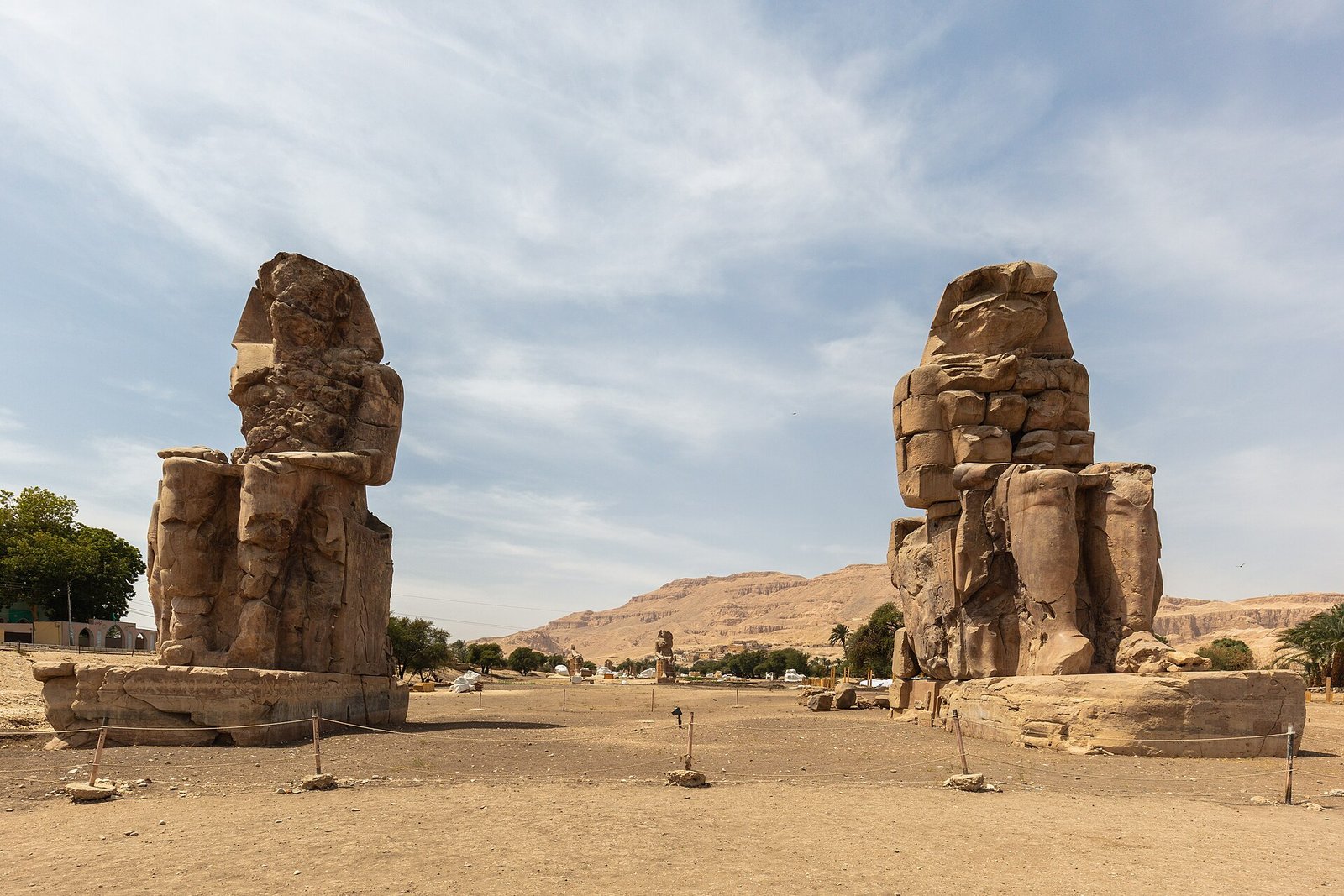
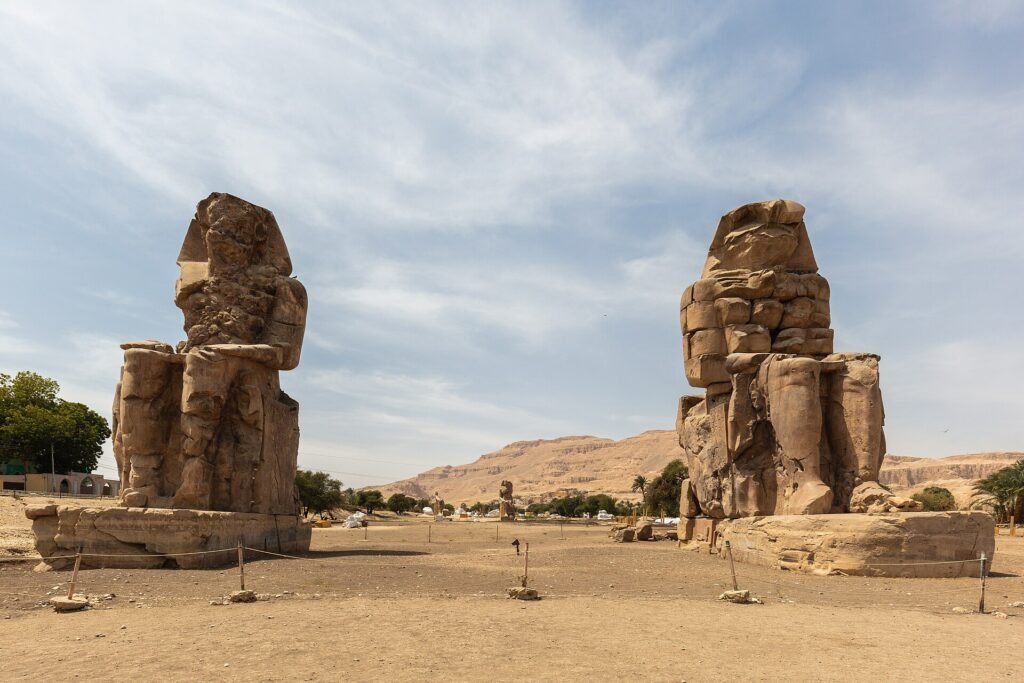
The Colossi of Memnon are two seated statues of the pharaoh Amenhotep III, each carved from a single block of quartzite and standing about 60 feet tall on the west bank of Luxor. They flanked the gate of his mortuary temple, the largest ever built in Egypt, which floods and later kings dismantled until only the two hardest things to move were left. An earthquake in 27 BC cracked the northern statue and it began to make a sound at dawn, which Greek and Roman travelers heard as the hero Memnon greeting his mother. They stand beside the road to the Valley of the Kings, cost nothing to see and take five minutes. Stop at first light on the way in.
What the Colossi of Memnon actually are
Strip away the Greek name and the legend and you are looking at two portraits of one man. Amenhotep III ruled Egypt in the fourteenth century BC, at the richest moment of the New Kingdom, and he liked to be seen at scale. Each statue shows him seated on a block throne, hands on his knees, wearing the nemes headcloth, facing east toward Karnak and the rising sun.
Beside his legs stand two much smaller women: his mother Mutemwiya and his Great Royal Wife Tiye, the commoner's daughter who became the most powerful queen of her century. Both reach only to his knee. The king is a giant and everyone else is human sized.
The throne sides carry a scene most visitors never see: two figures of Hapi, god of the Nile flood, knotting the lotus and the papyrus, Upper and Lower Egypt bound under one crown. For where the statues sit in the bigger picture, read the guide to Luxor's east bank and west bank.
The temple behind them, and why only the statues survive
The Colossi were never meant to be seen alone. They stood in front of the first pylon of the mortuary temple of Amenhotep III, a walled complex that ran west from the road for several city blocks and covered more ground than Karnak. Behind the first gate came a second pylon with more colossi, then a third, then a vast sun court, then the roofed sanctuaries.
The place was built to be flooded. It sat on the floodplain, so that each year when the Nile rose the outer courts filled with water and the temple seemed to rise from the primeval ocean of creation myth. As theater it was spectacular. As engineering it was a slow suicide.
Three things took it apart. Annual floods soaked the mudbrick and undercut the foundations for a thousand years. The pattern of fallen columns points to at least one major earthquake in the centuries after Amenhotep's death. And later pharaohs, Merenptah above all, hauled blocks and statues away to build their own temples. What survived was whatever was too heavy to be worth moving, and two seated statues of more than 700 tons each qualify. Compare the Ramesseum up the road, where Ramesses II built on higher ground and kept his walls.
The quartzite, the quarry near Cairo and the journey upriver
Almost every big statue at Luxor is sandstone from Gebel el Silsila, an easy float downstream from the quarries south of Edfu. The Colossi are not. They are quartzite, a sandstone fused by heat and pressure into something closer to glass, harder than granite to work and prized for a color that runs from honey to deep reddish brown depending on the light.
The accepted source is Gebel el Ahmar, the Red Mountain, on the eastern edge of modern Cairo, roughly 420 miles (675 km) downriver. Moving a 700 ton block that distance against the current, in the fourteenth century BC, gets less attention than it deserves because the pyramids soak up all the wonder. The blocks were roughed out in the quarry, dragged to the water during the flood, and carried south on lashed barges by the north wind that has always pushed boats upstream.
Two things follow from the stone. Quartzite does not weather like limestone, so the throne panels are still crisp after three and a half millennia. And it fractures rather than crumbles, which is why the northern statue snapped in an earthquake instead of eroding away, and why it sang.
The earthquake of 27 BC and the statue that sang at dawn
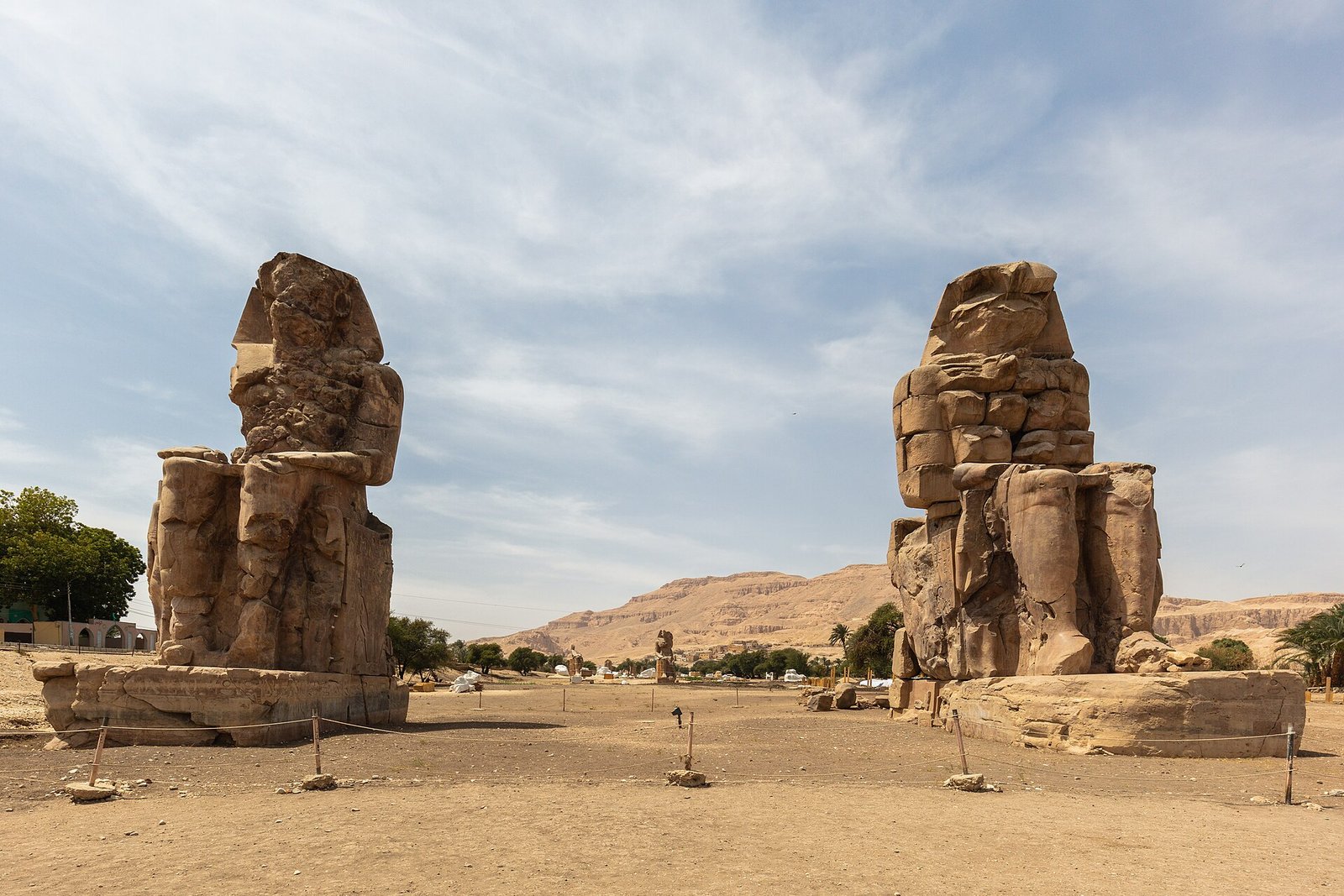
The northern colossus is visibly different from its twin: its upper body is stacked sandstone blocks rather than a single piece of quartzite. That is a Roman repair, and the damage it fixed is the start of the west bank's most famous story.
In 27 BC an earthquake shook Thebes. The northern statue cracked through the waist and everything above it fell. Egypt had just become a Roman province, and within a few years visitors began reporting that the broken statue made a sound at sunrise. The geographer Strabo heard it once and admitted he could not tell whether it came from the stone, the base or the crowd. Pausanias compared it to a lyre string breaking. It did not happen every day, which made hearing it a matter of luck.
The modern explanation is unromantic and convincing. Overnight, dew settled into the fractured stone. When the first sun hit the east-facing statue, the moisture flashed off and air moving through the warming cracks produced the note.
The proof is what silenced it. The emperor Septimius Severus, visiting Egypt toward the end of the second century AD, had the statue rebuilt with the sandstone courses you see today. The cracks were sealed, the physics stopped, and no one has heard the Colossus sing since. Repairing it killed the wonder.
Greek and Roman graffiti, and the day Hadrian came to listen
Walk to the legs of the northern statue and look at the shins and the pedestal. What look like scratches are more than a hundred inscriptions in Greek and Latin, carved by Roman-period visitors who came to hear the sound and wanted it known that they had. Prefects of Egypt, army officers, poets, tourists with no title at all, many stating plainly whether they heard the voice and in which year of which emperor. It is the oldest guest book in the world.
The most famous entries record the visit of Hadrian. The emperor toured Egypt with his wife Sabina and a court poet, Julia Balbilla, and the party came at dawn to listen. On the first morning the statue stayed silent. On the second it obliged, and Balbilla carved four poems in archaic Greek on the left leg and foot, recording the visit and the statue's good manners in greeting the imperial couple. A guide who knows where to look can still show you her lines.
The graffiti cluster on the broken northern statue, because people carved where the miracle happened, and they stop after the Severan repair. Modern visitors are asked, firmly, not to add to the collection.
Why they are called Memnon when they show Amenhotep
Memnon has nothing to do with Egypt. In Greek myth he was a king of Ethiopia, son of Eos, goddess of the dawn, killed by Achilles at Troy. His mother wept for him every morning, and her tears were the dew.
When Greek travelers heard a statue cry out at sunrise, in a country they thought of as the edge of Ethiopia, the identification wrote itself. The broken king was Memnon, the sound his greeting to his mother, the dew her tears. Amenhotep's name was still carved on the throne, but almost no Greek could read hieroglyphs, and Memnon made a better story.
So the answer to the question every guest asks in the first minute: no, they are not Memnon, not Ethiopian, and have no link to Troy. They are Amenhotep III, and he would have been unimpressed to learn that a Greek hero got the credit.
The excavation behind the statues, and why the view keeps changing
Older guidebooks describe the Colossi as two lonely giants in a field of sugarcane. That is no longer what you see. An international conservation project has been working on the temple site for many years and has transformed the view behind the road.
What has come out of the ground is startling. Further colossal seated statues of Amenhotep III, which stood at the second pylon, have been pieced together from fragments and raised again, so from the road you now see more than one pair of giants. Standing colossi in quartzite and alabaster mark the third gateway. An alabaster hippopotamus, sphinxes and a very large number of Sekhmet statues, the lioness goddess of plague and healing, have been recovered from the courts.
The area is fenced and not open for wandering, and what you can see depends on the state of the dig. So give yourself two extra minutes to walk to the northern end of the roadside area and look west. The re-erected colossi turn a photo stop into a temple, and most people drive off without noticing them.
The stop itself: free, roadside, five minutes
The Colossi sit directly beside the main road across the west bank, between the Nile and the ticket office for the necropolis sites. There is no ticket for the statues, no gate, no queue and no opening time; you can see them at any hour, and any driver will pull over on request.
On the ground you find a parking strip busy with buses and taxis all morning, a low fence and a short walk to the statues, close enough to read the graffiti on the legs, and vendors selling postcards and small stone figures. A friendly no and a step forward is all it takes.
Five minutes is the honest minimum: out of the vehicle, the photo, a circuit of the northern statue, back in. Fifteen minutes lets a guide show you the queens at the king's knees, the inscriptions and the re-erected colossi behind. For the tickets you will need at the sites after this, read the guide to the Valley of the Kings tickets and tombs.
Why dawn is the right time, on the way to the Valley of the Kings
The statues face east. From sunrise until late morning the light is on their faces and the quartzite glows amber. By early afternoon they are backlit, dark against a white sky. A silhouette can be a fine photograph, but if you want to see the stone, come early.
The second reason is heat. The west bank is a bowl of bare limestone that radiates by mid-morning, and in summer the Valley of the Kings can pass 104 F (40 C) by noon. Every good plan crosses the river at first light, goes straight to the tombs while they are cool and empty, and works back toward the river as the day warms. The Colossi are the first thing you pass on that road, so the natural moment is on the way in, with the sun just up, while the hot air balloons drift over the fields behind them.
The order that works:
- Cross the Nile at dawn, by bridge or motor launch.
- Stop at the Colossi while the light is on their faces.
- Valley of the Kings, three tombs on the general ticket, before the crowds and the heat.
- Hatshepsut's temple at Deir el Bahari, before the cliff behind it starts throwing heat.
- Medinet Habu, or the tombs of the nobles and Deir el Medina, for the quieter half of the west bank.
- Back across the river for lunch.
What a guide adds in five minutes
Nowhere in Luxor does a guide earn their place faster. Without one, you see two damaged statues and a fence. With one, in the same five minutes, you get:
- The two women. Tiye and Mutemwiya at the legs, and why a commoner queen ended up carved on the most public monument in Egypt.
- The graffiti. Which inscriptions belong to Hadrian's party and what they say about the voice.
- The temple. A turn to the west, the re-erected colossi, and the outline of a complex bigger than Karnak drawn in the air.
Our guides are licensed Egyptologists who speak clear English and have stood at this fence hundreds of times. They know where Julia Balbilla's poem is, which vendor to wave off, and exactly how long to stay so that you reach the Valley of the Kings before the first cruise buses. That timing is the difference between a quiet tomb and a queue. They also handle the tickets and the water, so your only decision at the Colossi is which side to photograph from.
How Explora Egipto slots the Colossi into your trip
We never sell the Colossi as a tour in their own right; they are a stop, not a destination. What we do is make sure every west bank morning we run begins there, at the right hour, with the right person talking, in one of three shapes:
| How you are visiting Luxor | When you see the Colossi | What else is in that morning |
|---|---|---|
| A Nile cruise between Luxor and Aswan | Dawn of the west bank day, straight off the boat | Valley of the Kings, Hatshepsut, often Habu, back on board for lunch |
| Two days in Luxor by land | Dawn of day one, after an optional balloon flight | The full west bank at an unhurried pace, Karnak and Luxor Temple the next day |
| A long day trip from Hurghada or Cairo by domestic flight | First stop after arrival, mid-morning | Valley of the Kings, Hatshepsut, lunch, Karnak, return the same evening |
Whichever shape fits, the vehicle and the guide are ours, and the timing is set the night before around your pace and the season. The Luxor excursions page shows the pieces, and every one of our Egypt tour packages that touches Luxor includes this morning as standard. Ask us for the quote and we send back a plan with the Colossi at sunrise on it.
Frequently asked questions
Do you have to pay to see the Colossi of Memnon?
No. The statues stand in the open beside the public road on the west bank of Luxor, with no gate, no ticket and no fixed hours, and you can walk up to the fence at any time of day. The paid sites beyond them, such as the Valley of the Kings and Hatshepsut's temple, have their own tickets, which a guide handles for you.
How tall are the Colossi of Memnon and how much do they weigh?
Each seated figure is about 60 feet (18 meters) high, closer to 66 feet (20 meters) with the pedestal, and was carved from a single block of quartzite weighing on the order of 720 tons, quarried near modern Cairo and brought more than 400 miles upriver. The northern statue is partly Roman sandstone above the waist, rebuilt after the earthquake of 27 BC.
Did one of the Colossi really sing?
Yes, for about two centuries. After the 27 BC earthquake cracked the northern statue, it made a sound at sunrise that Greek and Roman visitors described as a whistle, a moan or a snapping string, most likely dew evaporating as the sun warmed the fractures. Septimius Severus had it repaired at the end of the second century AD, and it has been silent since.
Why are they called Memnon if they are Amenhotep III?
Greek travelers who heard the dawn sound identified the statue with Memnon, the mythical Ethiopian king and son of Eos, the dawn goddess, killed at Troy. The morning cry became his greeting to his mother and the dew her tears. The statues themselves are portraits of Amenhotep III, with his mother and his queen Tiye at his knees.
Is the temple behind the Colossi open to visitors?
Not as a ticketed site. The mortuary temple of Amenhotep III is an active excavation, fenced off behind the statues. From the roadside you can see the re-erected colossi at the second pylon and the excavated courts, and a guide can explain the layout, but there is no path through the dig. What is visible changes with the work, so ask on the day.
What is the best time of day to visit the Colossi of Memnon?
Just after sunrise. The statues face east, so morning light falls on their faces and the quartzite shows its color; by afternoon they are backlit silhouettes. Dawn is also when you are already on that road to the Valley of the Kings, ahead of the heat and the cruise groups, and when the hot air balloons pass behind the statues.
Stand where Hadrian stood, at the same hour
Tell us your dates and how you are reaching Luxor, by cruise, by land or by domestic flight, and we send back a west bank morning that starts at the Colossi of Memnon with the sun on their faces, an Egyptologist at your side and the Valley of the Kings still empty ahead of you. Ask us for the quote.